
Kelso's Quest
Triple Crown at The Big A, 1961

Whisk Broom II, 1913.
Tom Fool, 1953.
Kelso…?
The question was a triple crown, but not one reserved for three-year-olds. New York’s handicap triple—the Metropolitan, Suburban, and Brooklyn—was extra-tricky. Instead of level weights for each race, the winner’s impost would keep rising. In 1961, would Kelso become just the third Handicap Triple Crown winner since 1891?
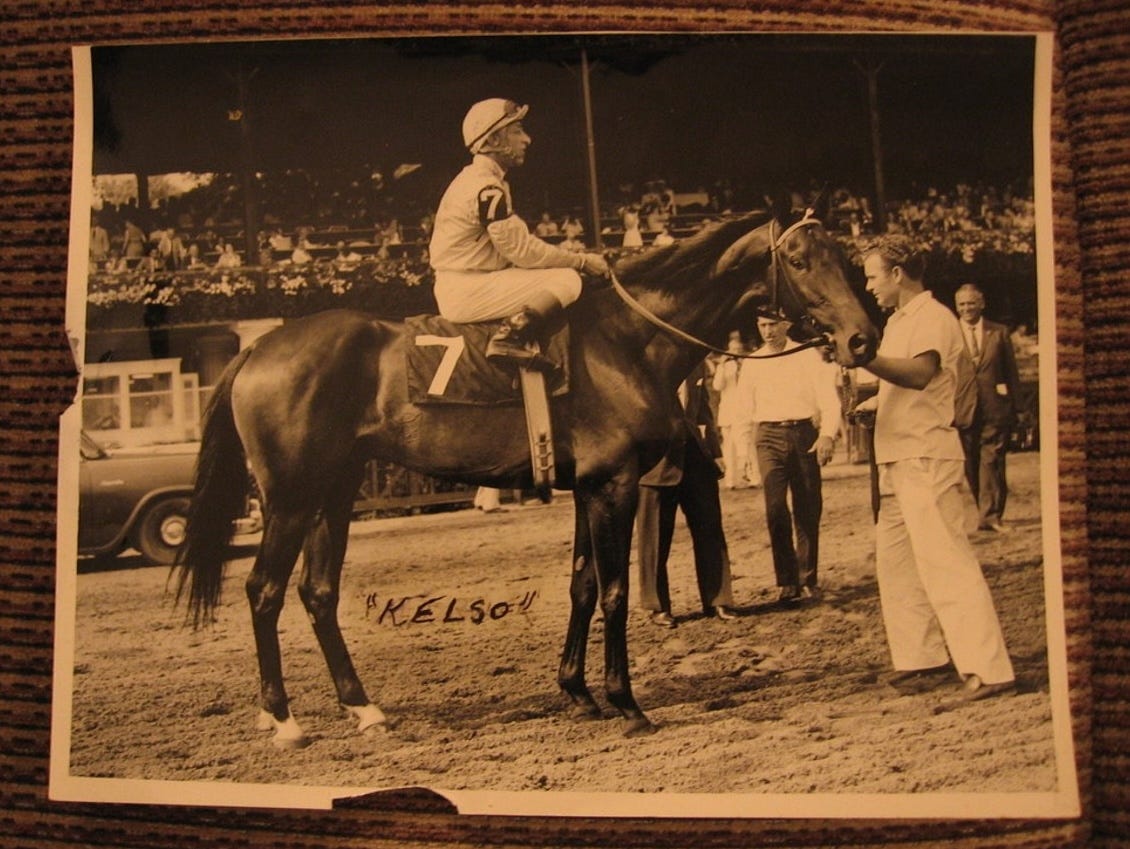
Belonging to owner/breeder Mrs. Richard C. (Allaire) du Pont and foaled at Kentucky’s illustrious Claiborne Farm, he was born a streamlined dark bay or brown colt with white hind feet and low white hind socks—an effect almost like wearing spats. Physically unimpressive as a yearling, he was gelded. Kelso would mature as a slim but medium-large individual, built for a long run in more ways than one.
For awhile the son of Your Host—Maid of Flight, by Count Fleet did not shout champion!—though as with many Thoroughbreds, top quality glimmered in his ancestry. Grandpa Count Fleet had won a Triple Crown (the 1943 Kentucky Derby, Preakness, and Belmont Stakes for 3-year-olds). His mama’s mama, Maidoduntreath, was an unraced daughter of Man o’ War.
At age two, Kelso won just one of three starts. At age three, the Bohemia Stable gelding didn’t try any Triple Crown activity. Not the Kentucky Derby, Preakness, or Belmont Stakes. Not the Metropolitan, Suburban, or Brooklyn Handicap. Coming on strong in summer and autumn, however, he beat older horses as well as his peers and got voted 1960 Horse of the Year.
But the handicap triple? Despite several brilliant performances, late-blooming Kelso hadn’t carried more than 124 pounds in a race. (Three-year-old Triple Crown contestants hefted 126.) After “Kelly” opened his 4-year-old campaign with a comfortable allowance win, New York handicapper Tommy Trotter made him the Metropolitan Handicap top weight with 130.
And yet, Kelso had made believers of the racing crowd. Memorial Day at Aqueduct racetrack in Queens, many of the 65,569 bet him for the Met. His seven-race winning streak inspired confidence and so did his rider: Hall of Famer Eddie Arcaro, aka The Master. Six times so far, Arcaro had partnered Kelso. They’d never been worse than first.
But as the saying goes, there’s a first time for everything. Three-quarters through the one-mile Metropolitan, Kelso was stuck in seventh place. Down the backstretch, he was blocked. Into the homestretch, runners in front of him fanned out for their rallies and Arcaro had a tough choice: steer Kelso super-wide or hope for a seam to open.
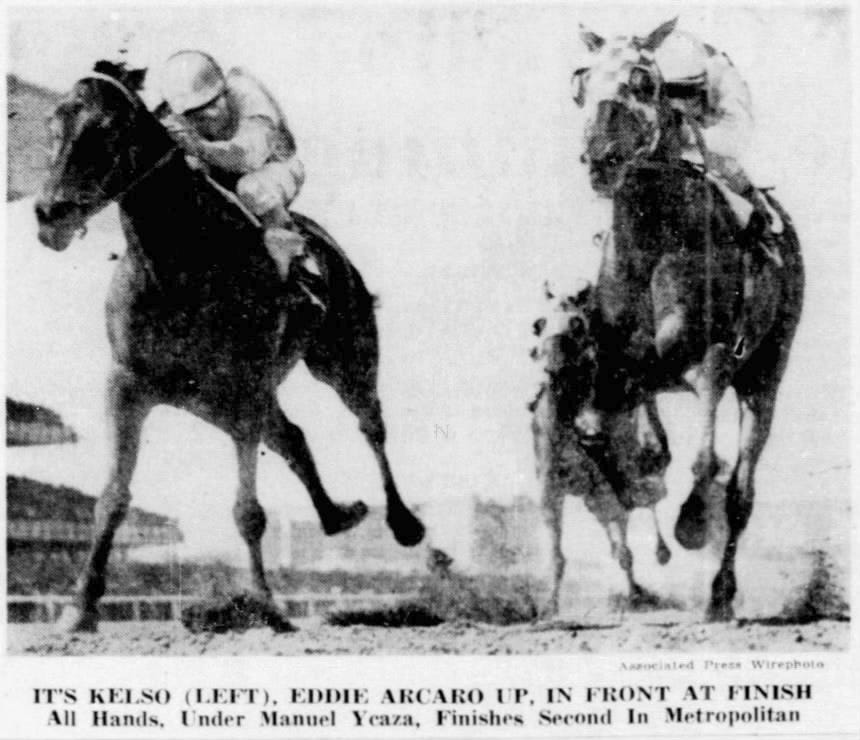
“I sure wasn’t going to try and loop the field with him carrying 130 pounds,” Eddie would tell Gene Ward of New York’s Daily News. “The crowd had given up on its even-money favorite as he swept out of the final bend,” Ward reported. “Kelso not only was back in the pack, but the field was spread out and Arcaro had no place to go with the champ. At the eighth pole there was running room, but All Hands, with Manuel Ycaza, had a fat lead and was showing no signs of losing his bounce.” Too late? But Arcaro saw space, at last, near the middle of the track. A furlong from the wire, Kelso shot through. Gene Ward compared him to a jet plane.
All Hands had been four lengths ahead; at the wire, it was Kelso by a neck. He burst the final quarter-mile in :23 1/5, even quicker than All Hands took the early command. “I had a hold on him in the backstretch, because I had no place to run,” Arcaro shared with Gene Ward. “I guess, maybe, that real run through the stretch was because I hadn’t let him run earlier and he had it all left.”
Bump
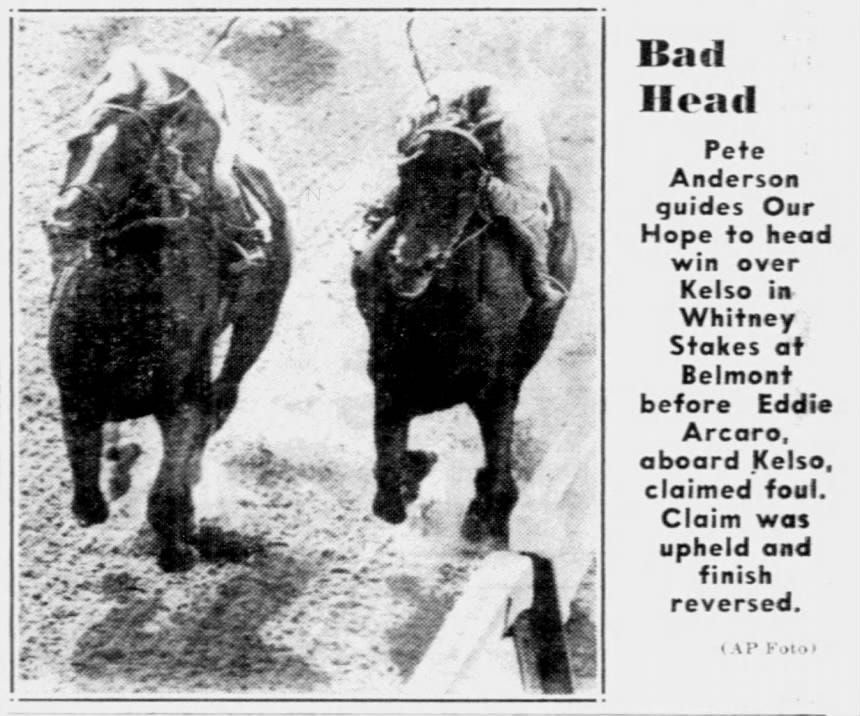
There’s a first time for everything nearly struck Kelso and Arcaro again before they dived back into the handicap triple. June 17 at Belmont Park, they crossed the finish line a head behind Our Hope in a ding-dong Whitney Stakes battle. “Official movies of the race showed that Our Hope crowded Kelso along the rail, and that Arcaro’s horse was thrown off stride with a bit less than an eighth of a mile to travel,” said the Associated Press (the AP). Our Hope jockey Pete Anderson told Jim McCulley of New York’s Daily News, “By the quarter pole, I’d nailed Kelso and I knew I had him then. I had him, too. I didn’t ride him any closer than he’d [Arcaro] have ridden me.” Arcaro told McCulley, “My stirrup hit the fence and the steel bent. The steel probably saved my foot, all I had was a little white [paint] on the foot of my boot. If Pete had given me running room I’ve got to believe I would have beaten him.”
Convinced there was a foul, the stewards disqualified Our Hope to second place. Kelso logged his ninth win in a row and took aim at the Suburban Handicap.
Across the U.S.A., sportswriters cheered the mass appeal of the gelding called Kelly. “Even if you’re not a horse racing buff you can admire his game qualities and his consistency,” Oscar Fraley of United Press International declared. “Because the Du Pont dandy has won 12 of the 15 races he has run. Finished second twice and been out of the money only once. His earnings amount to a neat and tidy $413,690 in less than three years—which is about what [baseball star] Mickey Mantle makes in six.”
Meanwhile, handicapper Tommy Trotter put three more pounds on Kelso’s back for the Suburban Handicap.
Rare Air
Since its first running in 1884, just five horses had won the Suburban lugging more than 130 pounds. Only Whisk Broom II, Grey Lag, and Bold Ruler had outdone Kelly’s 133. All were eventual Hall of Famers.
This history didn’t scare Aqueduct’s holiday crowd on Tuesday, July 4th. They made Kelso the odds-on favorite, paying just 60 cents on each dollar bet if he won—even though he spotted his nine opponents anywhere from 10 to 27 pounds. And despite the weights, they were right. This time Kelso enjoyed smooth sailing, stalking the leaders into the far turn and bounding away when Arcaro signaled him. At the wire he had five easy lengths on Nickel Boy, Talent Show, and Francis S. “The three horses in those spots could have been covered with a large blanket,” said John Chandler of the Associated Press. “But it would have taken a small circus tent to have reached out and gotten Kelso.”
“He did his job so easily that this is one time I felt pretty sure I had it won at the half-mile pole [a half-mile before the finish],” Arcaro told Dana Mozley of New York’s Daily News. “The race was just run to order for him. He was going so easy early, in fact, I had a little trouble slowing him down.” Sidney Cole, aboard third-place Talent Show, told Mozley: “He ran by us like an express train.”
Arcaro to the AP: “This was probably the best race Kelso’s ever run.”
Kelso (I imagine): “Hold my beer.”
The Stratosphere
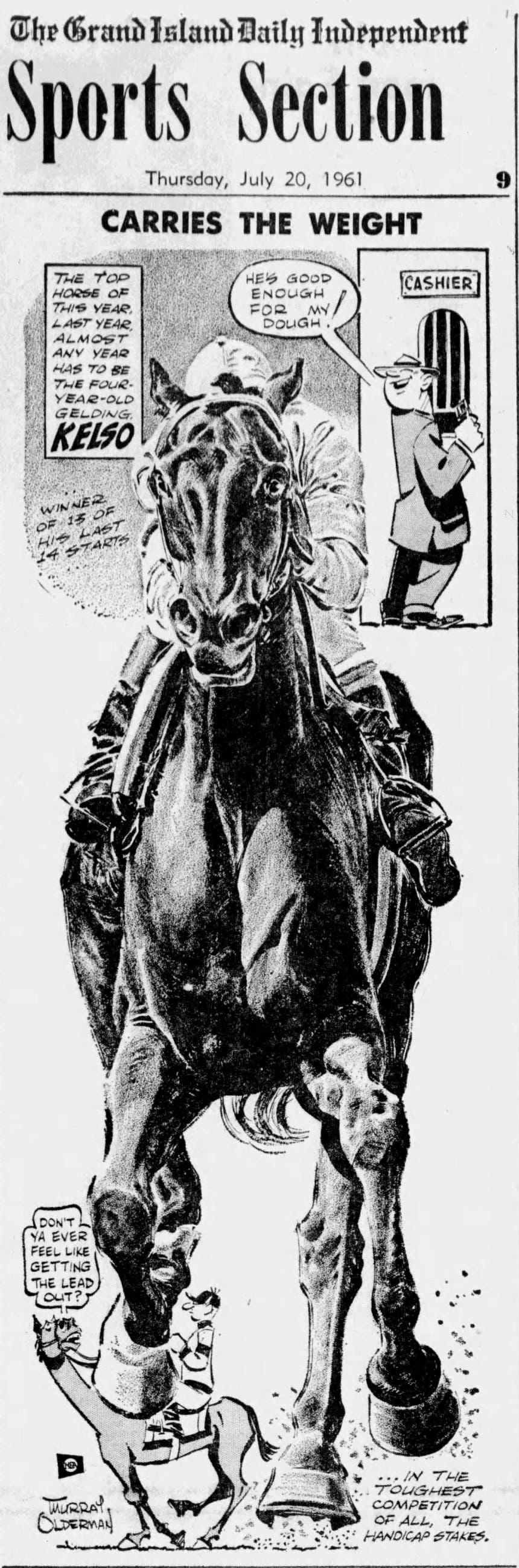
With two-thirds of a crown in hand, excitement escalated for plain dark brown or bay Kelly and The Big A’s July 22 Brooklyn Handicap. As early as July 13, a Murray Olderman cartoon hurtled through the Newspaper Enterprise Association (NEA) wires: “The Top horse of this year, last year, almost any year, has to be the four-year-old gelding KELSO.” Arcaro, who famously had called 1948 Triple Crown marvel Citation the best horse he’d ever ridden, dodged direct comparisons with Kelso but did say, “I never rode a horse more versatile.” Richmond (Virginia) Times-Dispatch columnist Chauncey Durden explained, “Kelso’s versatility was demonstrated last year when he won races from distances of six furlongs to 2 miles. Kelso ran the fastest mile run on any American track last year and broke Nashua’s record for the 2-mile Jockey Club Gold Cup by a full second.”
But the Jockey Club Gold Cup was weight-for-age, not a handicap. And as Tommy Trotter explained to Newsday, “The rule for handicappers is to give all horses an equal chance. The only way to put them together is to have freedom to put topweight [sic] on them. If a horse continues winning, like Kelso, you can’t tell what or how high the impost will be. It depends on the opposition and the manner in which the horse won.”
For the Brooklyn, Trotter loaded Kelso with 136 pounds.
This was not unprecedented, but it was a severe challenge. Only two Brooklyn winners—handicap champion Discovery in 1936, Handicap Triple victor Tom Fool in 1953—had hefted 136. None had carried more.
Friday, July 21, Kelly also withstood tense transit from Belmont Park to Aqueduct. The distance was just a few miles; the atmosphere, fraught. Grooms, hot walkers, and exercise boys on strike for better wages, plus benefits, had formed picket lines at the Belmont and Aqueduct gates. Police escorted the giant vans containing Kelso and other racers—and arrested seven picketers who threw sticks and bricks at the vans.
Brooklyn Handicap Saturday was another kind of hot: 94 degrees Fahrenheit. And still, most of the 35,013 who braved that heat believed in Kelso, 136 pounds and all—sending him off at 1 to 2, even shorter odds than the Suburban.
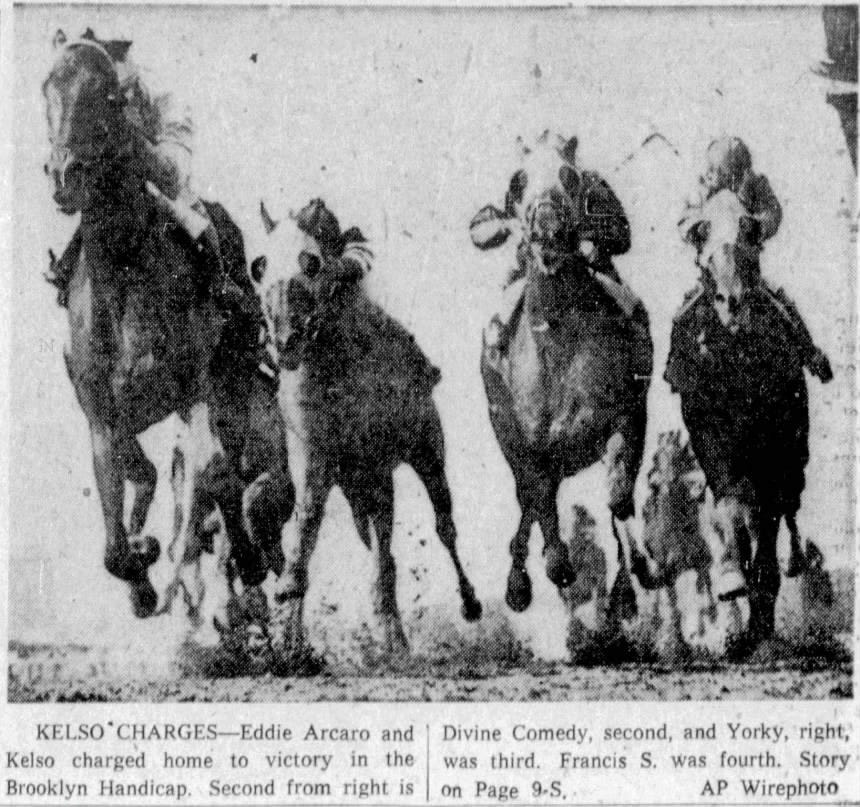
Kelly broke well from post seven of ten, but he and Arcaro were in no rush. Divine Comedy, starting widest of all, was. While Eddie steered Kelly to the inside, big, bold Divine Comedy cleared the field. While Kelso settled in third place, Divine Comedy led everyone around the clubhouse turn and opened up down the backstretch—about ten lengths on the next horse, Francis S., and fifteen on Kelso.
“I’ll tell you one thing, this 136 pounds really tried him,” Arcaro would admit to Jim McCulley of New York’s Daily News. “He was running good around the first turn and I figured that if that horse in front could win it there wasn’t anything I could do about it. I felt my competition was back there with me. I was just trying to keep control of the pack, I sure wasn’t going to kill Kelso chasing that one in front.” Divine Comedy carried a moderate 118 pounds.
Through the far turn, the field drifted up near Divine Comedy and Francis S., but the pace-setter and pace-stalker were not done. A quarter-mile from the wire, curling the last yards of the turn, Arcaro aimed Kelso out around Francis S. and drew his whip.
Kelly leveled out, game as always—but momentum built painfully slow, like Charles Lindbergh’s heavily encumbered Spirit of St. Louis taking off for the first successful trans-Atlantic flight. At the furlong pole he still was third, inches behind Francis S. and a fat length from Divine Comedy. But like Lindbergh’s airplane bouncing, bouncing, catching air, Kelso finally hit his stride and flew.
Full speed at the sixteenth pole and pulling away, Arcaro switching from whipping and flagging to hand-riding the final yards. Divine Comedy clung to second place, a length and a quarter back, while Francis S. lost third to late-running Yorky. Kelly stopped the clock at 2:01 3/5, just 2/5 above The Big A’s track mark.
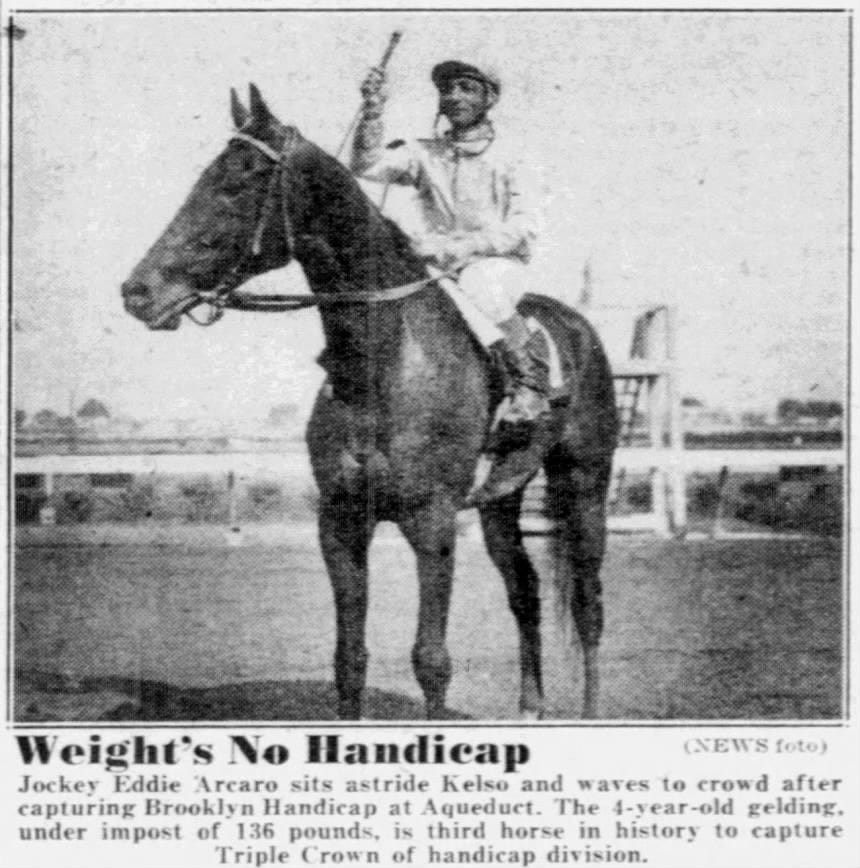
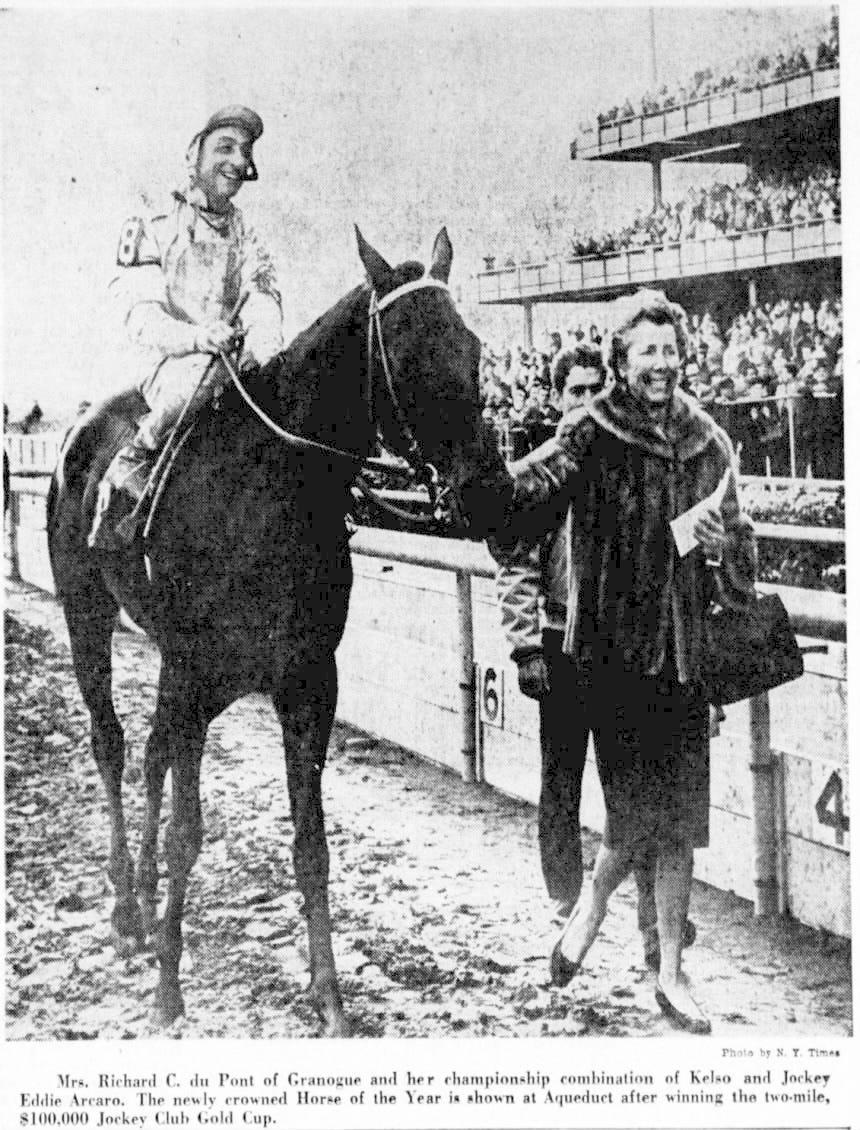
There was no special trophy for a Handicap Triple winner. Kelso gleaned the crowd’s acclaim, three rich purses, and a face-pat from Allaire du Pont’s white-gloved hand as his groom positioned him in the Aqueduct winner’s circle. Not yet halfway through his racing career, he was a slam-dunk prospect for the Hall of Fame. And G. Edward Arcaro, already enshrined with Citation, now had guided winners of two different Triple Crowns.
“The 136 was really telling on him and I’d say this was about as high on the scale as he can go, giving away as much weight as he did,” said Arcaro to reporter Jim McCulley. For various reasons, Kelso would not tote that much again in the rest of his career total 63 starts. Thanks to newsreel, we can glimpse the one time he did.
Kelso (#7) wins the 1961 Brooklyn and the Handicap Triple Crown
I was not yet born when Kelso was racing. But I do remember watching the TV broadcast when he, Forego, and John Henry made an appearance together at Belmont Park in 1983 before the Jockey Club Gold Cup. Kelso died the next day. Years later, when I visited Bohemia Farm in Maryland on the Railsitters Farm Tour, I got to see the memorial garden that Mrs. DuPont designed. Kelso was buried there alongside his sire and dam.